
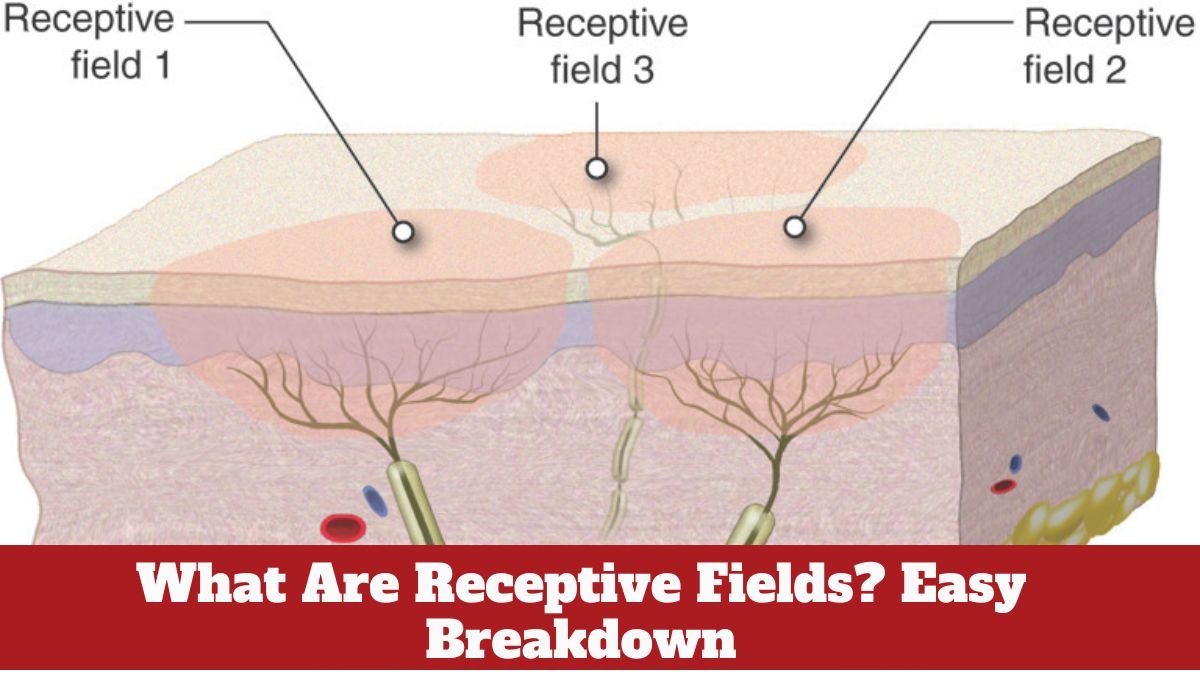
If you’re interested in neuroscience, AI, machine learning, or vision science, you’ve likely heard the term “Receptive Fields” mentioned somewhere. But to be honest, the term sounds a bit technical when you first read it. That’s why today we’ll explain it in simple, everyday terms—so anyone can understand it without a headache. This article serves as a quick review, clearly explaining the world of Receptive Fields with 10 key points.
What is a Receptive Field? — A Basic Introduction
In its simplest terms, a Receptive Field is the area from which a neuron receives information.
Imagine your eye looking at a scene. A small part of that scene activates a single neuron. That small area—that very area—is called that neuron’s “receptive field.”
This is a beautiful system in our brain, where each neuron handles a small part of the visual world. As these parts fit together, the entire image is formed in the brain.
Why is this concept important in our vision system?
Our eyes don’t capture the world as a single image, but rather send information in small chunks to the brain.
Each neuron monitors a specific area—some to see lines, some to detect edges, some to recognize light and shadow.
If there were no receptive fields, your brain wouldn’t be able to determine what you’re seeing—a cat, a car, or the morning sun.
Why are receptive fields small or large?
An interesting thing is that receptive fields aren’t the same everywhere.
The initial parts of the eye (retina and V1) have small receptive fields.
The brain’s further processing areas have larger receptive fields.
Smaller RFs capture fine details, while larger RFs create deeper understanding—like, “This isn’t just a moving line, it’s a human hand.”
How is this replicated in AI and Deep Learning?
Interestingly, Convolutional Neural Networks (CNNs) in AI also work on this same idea.
As the CNN’s layers increase—
The initial layer captures smaller features (edges, textures)
The next layer captures larger patterns (shapes, curves)
And finally, larger parts (like faces, objects, cars) are recognized.
That is, mimicking the human brain in its own style—“from small to large, from simple to complex.”
How does “activation” occur in the receptive field?
Each neuron is activated by a specific pattern.
For example, if a neuron likes straight, vertical lines, it will activate only when such a line is seen.
If a neuron likes moving things, it will respond only to movement.
It’s like some people only like spicy food, some only like sweet food—everyone has their own taste!
Receptive Fields Aren’t Static—They Change with Experience
Our brains aren’t rigid. RF patterns change with learning.
If you practice a skill daily—like painting, cricket, music—your brain becomes sharper and more efficient at processing those patterns.
This means that receptive fields also continue to be shaped by your experience, habits, and learning.
What does it mean to have large receptive fields?
A large RF means that the neuron is tracking a large area.
Example:
You see a car approaching from a distance. From a distance, the car appears as a small, blurry shape—neurons located in higher regions of the brain recognize it quickly because their RFs are large.
This means that larger receptive fields help us recognize things in a holistic way.
What does it mean to have smaller receptive fields?
Smaller RF means sharper focus.
- Small lines
- Fine edges
- Small patterns
Small receptive fields are responsible for capturing all of these.
Think of them like a microscope, which makes even the smallest objects appear clearly.
How were receptive fields discovered in research?
This concept was discovered in the 1950s and 60s by renowned scientists Hubel and Wiesel.
They conducted experiments on cats’ eyes and discovered that certain neurons only activated when a line in a specific direction was shown.
This is how the world learned how precisely and systematically the brain processes visual information.
Their discovery laid the foundation for both future neuroscience and AI.
How to remember receptive fields in a simple form?
Think of it as your eyes and brain playing a giant “puzzle game.”
Each neuron handles a small piece of this puzzle.
Small pieces combine to form larger pieces, and eventually, your brain understands the whole picture.
This is the entire philosophy of Receptive Fields—small pieces combine to understand the whole world.
Conclusion—A Simple Summary
Receptive Fields is a fundamental concept in both our brains and AI.
It explains how each neuron perceives only a small part of the world and, together with the rest of the neurons, creates the whole picture.
Small RFs capture details, larger RFs understand the whole object.
This system is so beautiful and scientific that whether you’re studying neuroscience, learning machine learning, or simply curious about how the brain works—Receptive Fields will transform your perspective.
