
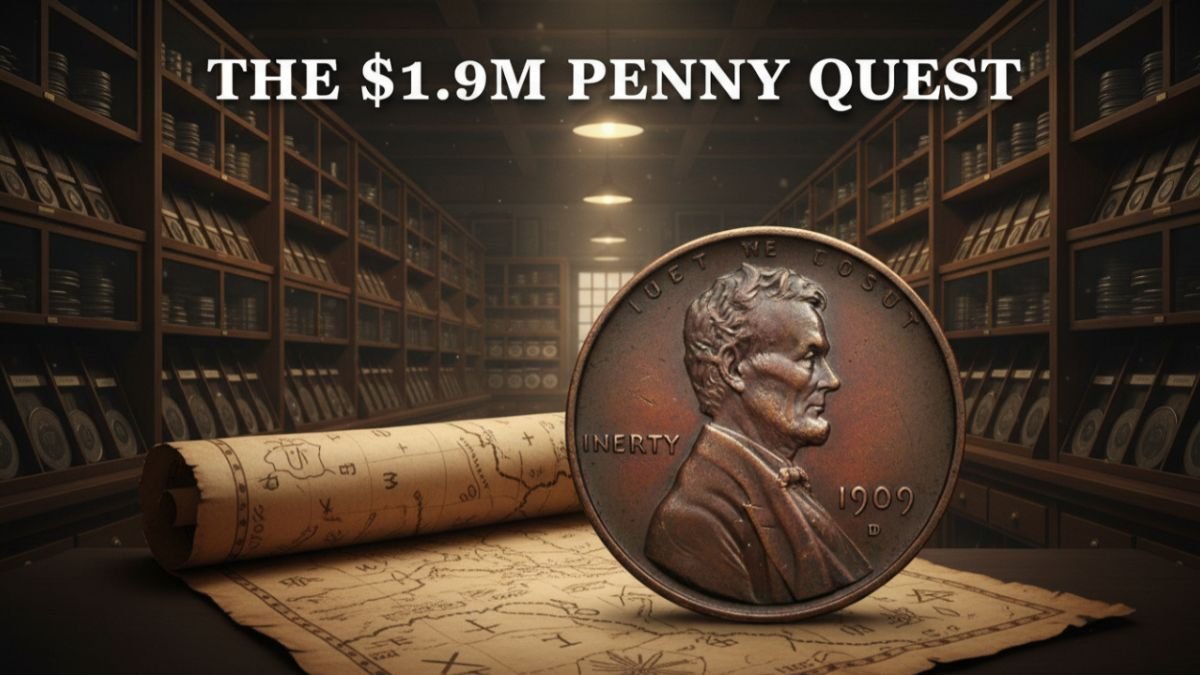
The world of coin collecting has always held a certain mystique. It blends history, art, economics, and human curiosity into one fascinating hobby. Among the countless coins that have passed through people’s hands over the years, few inspire as much excitement as the Lincoln Wheat Penny. And within that group, the legendary hunt for the rare 1.9 million Lincoln Wheat Pennies stands out as one of the most captivating quests in numismatic history. It is a story about rarity, perseverance, and the thrill of discovery that keeps collectors endlessly engaged.
A Coin with Humble Beginnings
The Lincoln Wheat Penny may seem like an ordinary coin at first glance, yet it carries a rich story. First introduced in 1909 to honor the 100-year anniversary of Abraham Lincoln’s birth, it became the first U.S. circulating coin to feature a real historical figure. Designed by Victor David Brenner, the coin’s obverse proudly displays Lincoln’s profile, while the reverse features two wheat stalks, symbolizing prosperity, growth, and the American spirit of resilience.
These pennies were minted by the millions and circulated widely, passing through grocery stores, farmer’s markets, and everyday households. Over time, however, certain years and mint marks became scarce due to limited production numbers, melting during wartime, hoarding, or accidental destruction. Among these, the mysterious 1.9 million–coin run emerged as a focal point for collectors worldwide, transforming an everyday penny into an object of fascination.
The Allure of Rarity
Rarity is the heartbeat of coin collecting. When only a small quantity of a particular coin is known to exist, its value is instantly elevated—both financially and emotionally. In the case of the 1.9 million Lincoln Wheat Pennies, their scarcity has created a near-mythical status in the numismatic community.
These coins were produced in significantly smaller numbers compared to other Lincoln Wheat Pennies. While some years saw hundreds of millions minted, the year associated with this 1.9 million run resulted in dramatically reduced output. No one could have predicted that decades later, collectors across the globe would be scouring their jars of spare change, coin albums, and inherited boxes in search of a small copper treasure that once passed quietly through everyday life.
The Coin That Sparked a Movement
At first, the 1.9 million Lincoln Wheat Penny was just another coin in circulation. But as the numismatic community grew and mint records became more closely studied, collectors realized just how few of these coins were still in existence. Some had been lost forever. Others were worn beyond recognition. A small number were preserved by chance or by the foresight of dedicated collectors.
Once word spread, a global treasure hunt began. Enthusiasts began examining every penny more carefully. Coin shows buzzed with quiet conversations about rumored discoveries. Auction houses watched as prices climbed steadily. Suddenly, the humble penny was no longer just pocket change—it was a symbol of possibility, luck, and adventure.
History Hidden in Copper
Part of what fascinates people about these coins is the history they silently carry. Imagine a Lincoln Wheat Penny minted nearly a century ago. It may have been used during the Great Depression to buy a loaf of bread, or slipped across a store counter during wartime. It might have traveled across states in a farmer’s pocket, or rested for decades in a dusty attic before being rediscovered by a curious grandchild.
Holding such a coin is like holding a time capsule. Collectors speak not only of financial worth but of emotional value. The faded color, the softened edges, and the tiny scratches all tell a story. Each mark represents a moment in time. Every coin has lived a life, and the 1.9 million series adds yet another layer of intrigue because of its rarity and the mystery of its survival.
The Thrill of the Hunt
What keeps people searching for these pennies year after year? The answer lies in the thrill of possibility. For many collectors, the greatest joy is not just in owning a rare coin, but in discovering it. The idea that something incredibly valuable could still be hiding in an old jar, a forgotten safe, or a random coin roll from the bank is intoxicating.
Some discoveries happen in the most ordinary moments. A person might be sorting through inherited belongings and find a small pouch filled with old coins. A child might receive change at a roadside shop and unknowingly pocket a historical artifact. These stories continue to surface, fueling excitement and hope among collectors across generations.
Condition Is Everything
While the rarity of the 1.9 million Lincoln Wheat Penny already makes it highly desirable, its condition plays an equally important role. Coins graded as “uncirculated” or showing minimal wear can command prices many times higher than heavily worn examples. This is why collectors handle these coins with extreme care, storing them in protective holders and keeping them away from air, moisture, and skin oils that could cause damage.
Professional grading agencies now authenticate and evaluate coins, assigning them standardized grades that reflect their condition. Certification not only reassures buyers of authenticity but also significantly increases the coin’s market appeal. For some collectors, receiving a high grade on one of these rare pennies is the ultimate validation of their efforts and patience.
More Than Money: A Community of Passion
Behind the figures and auction prices exists a deeply passionate and welcoming community. Coin collecting brings together people from all walks of life—students, historians, retirees, investors, and dreamers. Clubs, online forums, exhibitions, and auctions have become meeting places where stories, discoveries, and knowledge are exchanged freely.
The quest for the 1.9 million Lincoln Wheat Penny has strengthened this sense of community even further. It has inspired research projects, magazine articles, videos, and lively debates. For many collectors, the coin itself is simply a gateway into a broader appreciation of history, craftsmanship, and the evolution of American currency.
The Modern-Day Treasure Hunt
Even today, in an increasingly digital world where physical cash is used less often, the allure of the Wheat Penny remains undiminished. Metal-detecting hobbyists sweep fields and old homesteads. Estate sales are combed through with renewed curiosity. Banks still regularly receive requests for boxes of coin rolls from hopeful searchers determined to try their luck.
Every new discovery adds to the legend. Occasionally a rare penny appears at auction and creates widespread excitement. Others slip quietly into private collections, cherished not only for their value but for the story behind the find. The narrative continues to evolve with every new generation of collectors, each one adding its own voice to the enduring story.
Lessons from the Lincoln Wheat Penny
At its core, the story of the 1.9 million Lincoln Wheat Penny is far more than a numismatic curiosity. It is a reminder that extraordinary value can hide inside the most ordinary-looking things. A small copper coin that once purchased chewing gum or a newspaper now stands as a symbol of history, patience, curiosity, and perseverance.
It teaches us to look more closely at the world around us, to appreciate the quiet beauty in craftsmanship, and to recognize that even everyday objects can become treasured pieces of heritage. Above all, it celebrates the timeless human instinct to search, discover, and preserve the past.
Conclusion
The quest for the 1.9 million Lincoln Wheat Penny is a journey that rarely ends with a single discovery. Instead, it continues through the shared excitement, research, storytelling, and hope that define the coin-collecting community. As long as there are forgotten drawers, dusty attics, and unsorted jars of change, the dream of uncovering one of these rare pennies will live on.
Whether or not a collector ever holds one in their hands, the spirit of the search itself is priceless. It connects people to history, to one another, and to a sense of wonder that is often lost in modern life. And that is why the legend of the Lincoln Wheat Penny continues to shine—quietly, like the soft gleam of copper that refuses to fade with time.
FAQs
Q1. What is the 1.9 Million Lincoln Wheat Penny?
A. It refers to a rare Lincoln Wheat Penny believed to be worth up to $1.9 million.
Q2. Why is it so valuable?
A. Because of its rarity, condition, and historical importance.
Q3. When were Lincoln Wheat Pennies made?
A. They were minted from 1909 to 1958.
