
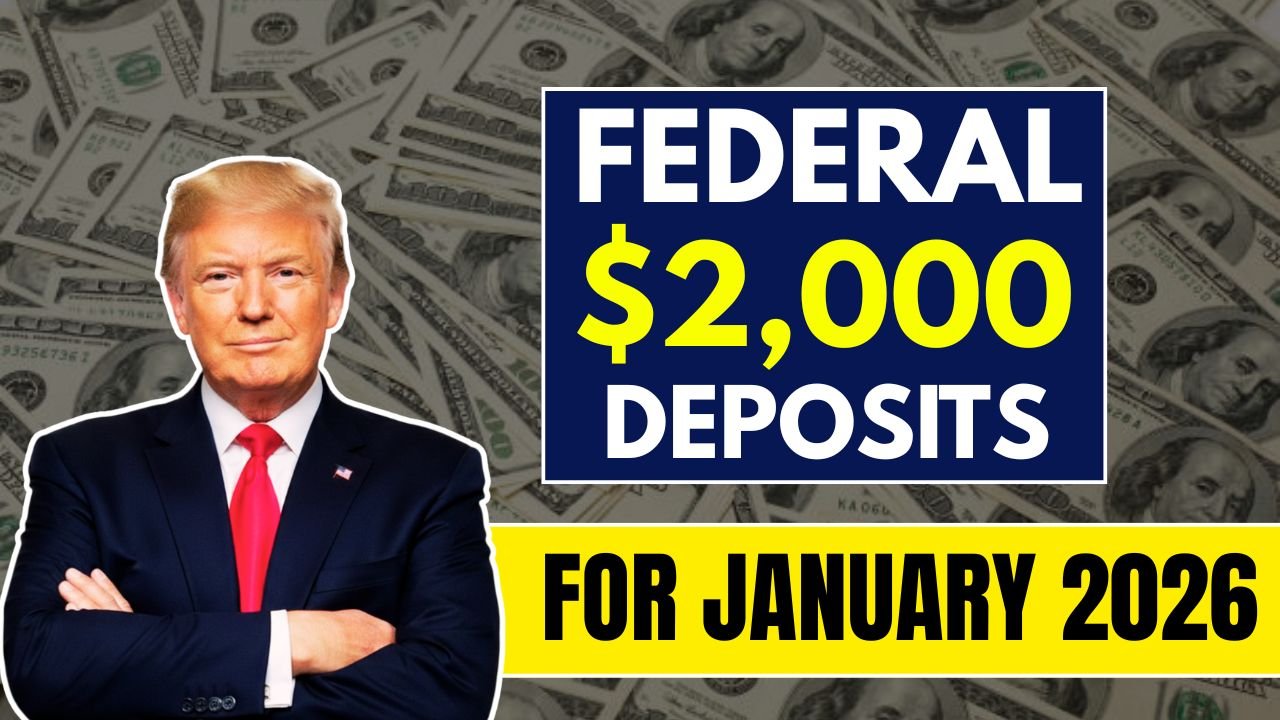
Federal $2,000 Deposits Coming in January 2026: Recently, White House National Economic Council Director Kevin Hassett reiterated President Donald Trump’s promise of a $2,000 stimulus check. This amount would be given to American families, and the funding is planned to come from tariff revenue collected in 2025. Hassett said on December 21st, “In the summer, I wasn’t sure there was room for such a check, but now I’m quite confident that it’s possible next year.” He cited the declining deficit in the US and economic growth of nearly 4% as the main reasons behind this confidence.
However, there are two major obstacles behind this optimistic announcement. First, the potential skepticism of the Supreme Court, which could challenge the legality of the tariffs, and second, expert analysis that suggests “the numbers simply don’t add up.” Due to these two factors, the success of this plan does not seem entirely assured.
Trump’s Big Stimulus Check Promise
President Trump has dubbed this plan a “tariff dividend.” According to this proposal, every eligible American citizen would receive at least $2,000. This would exclude high-income individuals, and there would likely be some limitations for families with an annual income of less than $100,000.
According to Kevin Hassett, the President will formally propose this to Congress in 2026 to authorize these payments, as these checks cannot be issued solely through an executive order.
Financially, this amount is supposed to come from the global tariff revenue that Trump implemented this year. In 2025, these tariffs generated $195 billion in revenue, an increase of more than 150% compared to the previous year.
Why the Skepticism About Tariff Revenue?
However, some non-partisan budget organizations are questioning the viability of this plan. The Committee for a Responsible Federal Budget (CRFB) and the Center for Tax Policy estimate that the tariffs will generate between $200 billion and $300 billion in revenue annually.
But the cost of providing a one-time payment of $2,000 to most adults and potentially children would be approximately $600 billion, roughly double the estimated annual revenue. John Ricco, an analyst on the matter, stated, “Clearly, the incoming revenue will not be sufficient.”
This financial gap means that if the government wants to fund the dividend, it would likely have to increase the deficit, contradicting the claim that the tariffs would reduce the national debt.
The Legal Complexities Behind the Stimulus Check Promise
The legality of the tariffs, which are the funding source for this dividend, hangs by a legal thread. On November 5, the Supreme Court heard a case on whether Trump exceeded his authority under the International Emergency Economic Powers Act (IEEPA) in imposing the tariffs.
During the hearing, several justices from the conservative bloc, including Chief Justice John Roberts and Justice Amy Coney Barrett, expressed deep concern and skepticism. Roberts questioned whether a vaguely worded law could be used to grant the power to “impose tariffs on any product, from any country, in any amount.”
The Future of the Tariff Stimulus Check
If the Supreme Court rules against the administration, it would have an immediate and significant impact. Not only would the validity of the tariffs be revoked, but the government would also have to consider refunding the approximately $90 billion in tariffs already paid by companies. Judge Barrett described this process as “utter chaos.”
In this scenario, the funding source for the dividends would either disappear or be used for refunds instead of checks. Hassett himself acknowledged that if the opposing ruling comes down, making widespread payments would become quite complicated.
Treasury Secretary Scott Bessent added further ambiguity, stating that this “refund” could also take the form of existing tax cuts, not new checks. Meanwhile, the market is watching this closely. Wells Fargo analysts estimate that if the Supreme Court strikes down the tariffs, S&P 500 companies’ profits could increase by 2.4% in 2026, easing pressure on their margins. The clothing, toy, and automotive sectors, which are particularly reliant on imports, are likely to benefit the most.
Conclusion
Trump’s promise of a $2,000 stimulus check raises hopes for financial relief for American families, but its success hinges on several significant economic and legal hurdles. Funding through tariff revenue, legal challenges, and financial doubts raised by experts make it far from straightforward. If the Supreme Court strikes down the tariffs, the entire plan could be in serious jeopardy.
Currently, American families are awaiting the outcome of this promise, and it remains unclear how many families will actually receive this financial relief in 2026. This case is not merely an economic plan but a complex mix of legal and political equations that will impact both the American economy and the public.
FAQs
Q1. What is the $2,000 stimulus check proposal?
It is a plan by former President Trump to provide $2,000 per eligible American, funded by tariff revenues, excluding high-income individuals.
Q2. How will the stimulus checks be funded?
The funding is proposed to come from revenue generated by global tariffs imposed by the Trump administration, which raised $195 billion in 2025.
Q3. Are the stimulus checks guaranteed?
No. Legal challenges to the tariffs and budget concerns make the plan uncertain. The Supreme Court could potentially invalidate the tariffs.
Q4. When will the proposal be submitted to Congress?
According to Kevin Hassett, Trump plans to submit a formal proposal to Congress in 2026, as payments cannot be issued by executive order alone.
Q5. What happens if the tariffs are overturned?
If the Supreme Court strikes down the tariffs, the government may have to refund importers, and the funding for the stimulus checks could disappear or be redirected, making widespread payments unlikely.
