
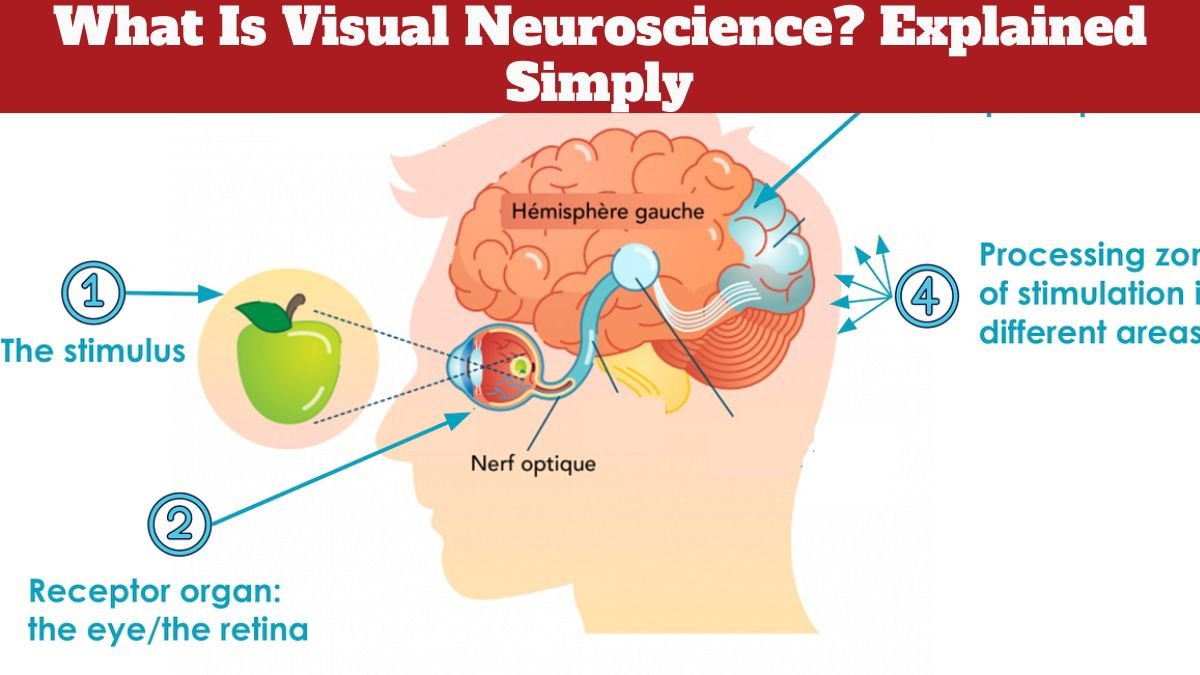
Our eyes capture countless images, colors, shapes, and movements every day. But have you ever wondered where the actual analysis of what we see takes place? The answer is – our brain. Visual neuroscience is the science that explains how our eyes and brain work together to perceive the world.
This blog will explain in simple terms how this entire system works, why it’s important, and how it could change our lives in the future.
Let’s embark on this simple yet fascinating journey…
What is visual neuroscience? – A simple definition
Visual neuroscience is the branch of science that studies how the brain and eyes work together to accomplish the process of seeing. It attempts to understand how light travels to our brains when we look at something and how it is converted into a recognizable image.
Simply put, visual neuroscience explains that seeing is not just a function of the eyes, but rather the result of extensive brain processing.
Eyes are just cameras; the brain creates the real image
Our eyes work like a high-quality camera. They capture light, but don’t interpret it. The real magic begins when this information reaches the brain.
The brain processes this information in several stages, and then we perceive what we’re seeing—whose face it is, what color it is, what shape it is, whether the object is stationary or moving.
That is, “seeing” is a mental process, not just an eye-based ability.
The Beginning of Visual Processing—A Story Starting with Light
Whenever something is in front of our eyes, light emitted or reflected from it enters our eyes. This light reaches the retina, the most important part of the eye.
Special cells called photoreceptors in the retina convert this light into electrical signals, which are then transmitted to the brain.
This is the first step that begins the journey of “seeing.”
Optic Nerve – The Express Highway from the Eyes to the Brain
Signals generated by the retina reach the brain via the optic nerve.
Think of it as a high-speed information line between the eyes and the brain.
It transmits millions of data packets, or visual signals, to the brain every second.
If the optic nerve is damaged, vision can be significantly reduced or even lost, as it is our main visual connection.
The Brain’s Visual Cortex – The Real Analyzer of Images
When the optic nerve transmits signals to the brain, these signals travel to the visual cortex. This is the area of the brain that analyzes images.
Here, the brain recognizes different things, such as:
- What color is it?
- What shape is it?
- Is the object near or far?
- Is it fixed or moving?
This process is what allows you to recognize your friend in a crowd or react quickly to an approaching vehicle.
The Brain Creates a Story of the Entire Scene
Information about each object is divided into different parts—color, shape, distance, movement. But the brain doesn’t keep them separate.
Visual neuroscience shows that the brain combines all this information to create a complete story, which we perceive as a real scene.
Example:
If you are standing in a garden—
- The green color of the leaves
- The shape of the flowers
- Trees swaying in the wind
- Flowing water nearby
The brain presents all of these as a complete scene.
Visual Memory – The brain even remembers old pictures
According to visual neuroscience, our brain not only sees but also remembers.
When you see a face, your brain stores it in its memory bank.
This is why you recognize a friend in a crowd, remember the way home, or recall a brand name upon seeing its logo.
This means seeing not only means understanding the moment, but also preserving it for the future.
Our Brain Makes Mistakes – The Secret of Optical Illusions
Have you ever seen pictures in which the brain is deceived?
These are called optical illusions.
Visual neuroscience shows that our brain often makes guesses to complete incomplete information.
Sometimes these guesses are wrong, and we don’t see things as they actually are.
The brain is very smart, but sometimes even it can be deceived!
The Importance of Visual Neuroscience – Why It’s Important
This science not only explains how we see, but it also has many real-life applications—
- Treating eye diseases
- Identifying brain-related visual disorders
- Improving robotics and AI
- Vision systems in self-driving cars
- Virtual Reality (VR) and Augmented Reality (AR)
If we understand how the brain sees, we can create machines and technologies that perceive the world like humans.
The Future – How Visual Neuroscience Can Change the World
Major revolutions are possible with the help of this science in the future.
- Glasses that help blind people see
- Brain-computer interfaces that can control screens using the mind
- AI systems that can “see” like humans
- New developments in medical imaging and surgery
The future may be a world where brains and machines work together, making vision even faster, clearer, and more advanced.
Conclusion – The ability to see is our brain’s most amazing skill.
Visual neuroscience helps us understand that seeing isn’t just a simple task. It’s the result of complex, rapid, and amazing brain processing.
Whenever you see a beautiful sight, recognize a face, or perceive motion—remember, your eyes are just the camera; your brain does the work.
