
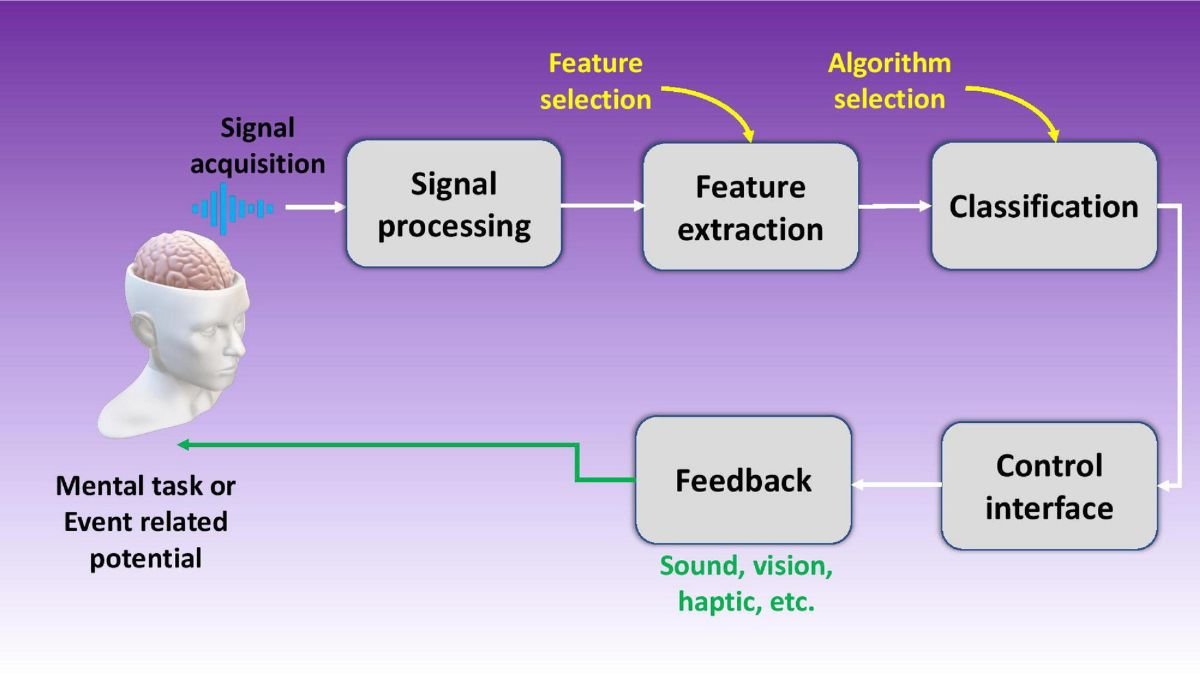
How Brain-Machine Interfaces Use Visual Signals: Today, directly connecting the human brain to machines is a rapidly evolving technology that leads to the concept known as brain-machine interface or brain-computer interface. This emerging technology is taking us towards solutions that a few decades ago could only be imagined in science-fiction movies. Specifically, the area of visual signal-based BMIs has been a significant source of new hope in medicine, communication, and robotics. Essentially, these devices detect the visual stimuli one focuses on, and the brain generates certain types of waves to indicate the specific stimuli. The system then reads those waves and converts them into commands. The entirety of the operation is done smoothly, safely, and in a sophisticated manner.
How BMI Works with Visual Signals
One of the main methods of a brain-machine interface is showing different visual stimuli on a screen in front of the user. The stimuli may be in the form of characters, letters, or even flashing lights. Upon selection of one of these by the person, a certain frequency or brainwave is generated in the brain. Devices such as EEG recognize this activity and a computer interprets it and acts accordingly. To illustrate, if a user watches a light that blinks at a certain frequency, the brain adapts that frequency. This adaptation then directs the system what the user is choosing. Correspondingly, in another example, if a user is concentrating on a letter or an option, then the brain emits a wave called “P300” which the BMI identifies and uses to comprehend the user’s thought.
SSVEP: A Powerful Attention-Based Wave Technology
One of the common methods used in BMIs is Steady-State Visually Evoked Potential, also known as SSVEP. This is a process in which the user focuses on an image that blinks at a specific frequency. The brain’s visual cortex pays attention to the blinking and generates brainwaves of the same frequency. This provides a very stable and reliable signal, allowing the system to easily understand the user’s choice or command. The greatest advantage of this technology is its fast operation and low error rate. Therefore, it is used in critical areas such as communication and control.
P300 Speller: Identifying Options That Come to Mind
Another example of a visual-based brain-machine interface that greatly enhances human capabilities is the P300 Speller. This concept involves a grid filled with letters, words, or signs turning up in front of a user. Every single element of the grid changes its color or flickers for a brief period. P300 is the special type of positive brainwave generated by the user’s brain about 300 milliseconds after the user concentrates on a certain letter or option. The BMI identifies this wave and thus, the very first action it takes is to choose the letter or command with which the person was focusing. People who have lost the ability to talk or write can totally rely on this technology in a way that it has become their second nature. With just the help of their eyes and attention, they can pick words on a computer and get their messages across.
Visual Tracking: Controlling Cursor Direction with the Brain
One can control the mouse on a PC just by using the power of their mind. It used to be a dream but now it is a fact. The main principle behind visual tracking-based BMI systems is that the users can easily and quickly control any object available on the screen just through the use of their eyesight and attention. The device always stays tuned to brainwaves and accordingly, it takes into account both the direction and the speed of the cursor from the signals obtained. Often, a system is described as “learnable” when the user gradually gains control over his or her brain activity and the system simultaneously becomes synchronized with the user’s habits. The technology is also involved in playing sports, chatting, and even medical rehabilitation.
Real-Time Training and Neurofeedback Involving Visual Cues
Neurofeedback is an extremely advantageous and progressively expanding area just at present. Visually guided BMIs have a considerable influence in this sector. The user sees the brain activity displayed by a device right at that moment on a screen. Hence the user gradually masters how to control attention, lower stress and improve cognitive functions. Take ADHD for instance, the kids suffering from this disorder can get a lot out of this kind of mental training as it teaches them to focus more. Also, the same training can be of great help to athletes, students, and analysts who are willing to take their mental powers to a higher level.
Revolution in Communication and Control
The biggest advantage of visual-based brain-machine interfaces is that they give new life to those who, due to their physical limitations, cannot speak, walk, or express their desires. Many patients can type words on a computer, browse the internet, or control devices like wheelchairs simply by moving their eyes. This technology has given hope to millions of people and helped them regain control over their lives. This independence is not only physically significant but also highly motivating mentally and emotionally.
The Future of Artificial Vision and Cortical Prosthetics
In some advanced systems, visual signals from an external camera are sent directly to the visual cortex of the brain. This technology, known as cortical prosthetics, is used to help people who have lost their eyesight. While this technology does not restore completely normal vision, it can help them recognize light patterns, shapes, and moving objects. This makes a huge difference to their quality of life. This scientific achievement suggests that in the coming years, we may be able to develop systems that can give a blind person a near-normal vision experience.
Technology, the Human Brain, and the Decades to Come
Brain-machine interfaces are not just a technology, but a medium that challenges the limits of human capability. They teach us how the brain signals, how it responds, and how machines are learning this amazing language. Now, through visual-based BMIs, Communication that previously seemed impossible has become possible. Scientists are constantly working to make these systems more accurate, faster, and secure. In the coming decade, this technology will find its presence not only in the medical field but also in education, training, security, and entertainment—everywhere.
Conclusion: A Beautiful Fusion of Human Emotion and Technology
Visual signal-based brain-machine interfaces are a remarkable fusion of humans and technology. They not only reflect the advancement of science but also demonstrate humanity’s compassion and hope. Whether it’s SSVEP, P300 spellers, or visual tracking, each technology honors and reshapes the capabilities of the human brain. Continued research and innovation in this field suggest that the world will be even more interactive, accessible, and human-centered in the future. This is not just the evolution of machines, but a journey to enhance human freedom, self-esteem, and quality of life.
